
A bit about kit
Little Big Camera
I’ve so far avoided writing a ‘what’s in my camera bag’ blog post, mainly because I think it would be better conveyed in a video, but partly because I think it’s, shhh, a bit boring… However, I have been asked a few questions, and responded to some fellow photographers with my take on photography; why I use the gear I use, why I have certain settings on my cameras, and my approach to shooting certain scenes. So I thought I’d share some of that stuff, along with some unaffiliated shopping links to bits of kit that you might find useful.
Personal Shopper
Before I start, you should note that I’m something of a shopaholic. I absolutely love it; buying for me, or anyone else. Retail is my therapy. Whether it’s a tiny widget for a few quid or a new house, a purchase satisfies a need. I do the research. I weigh up the pros and cons. My analytical background has seen me delve deep into pairwise comparisons and decisioning tools. The product manager in me considers the problems to be solved and the emotional aspects of a purchase. YouTube review hours are well spent. Having taken early retirement on a significantly reduced pension, affordability and value for money have leapt up the weightings. Buy cheap, buy twice is still a mantra to be considered, but ‘if you can’t afford it, look elsewhere’ is where I’m at today. Photography is an expensive game, so I hope this helps.
The multitool: Fujifilm X100V
I don’t always get it right (see also my camper van debacle); I used to be a Canon full-frame man, with the so-called holy trinity of lovely L-Series lenses. I took some nice photos, but man, that gear was huge, heavy, and dare I say it, dull. I sold the lot at quite a hit and nearly lost interest in photography altogether, but on something of a whim, got my hands on a new Fujifilm X100V; amazing, given the rapidly developing, global adoration for it at the time. It’s a superb, engaging little camera that fits easily in the central console of my car. It’s nearly always with me. Its fixed, 23mm focal length lens and APSC sensor don’t scream landscape photography, but the built-in ND filter, the addition of the manufacturer’s screw-on wide angle adaptor, a tiny circular polariser, and a minimalist, leather half case that incorporates an Arca-Swiss plate to mount it on a tripod (no longer available, but here’s the same case for the X100VI) , combine to turn this thing into the landscape photographer’s equivalent of a pocket multi-tool. The tiny flash adds a little in-fill lighting for back-lit studies. I even shot my daughter’s wedding on it. I shoot RAW, and rarely, if at all, use straight-out-of-camera JPEG files. I’m not that bothered with kooky film recipe settings, although it is impressive just how much creative flexibility is packed into this wee thing.
The big(ish) guns: Fujifilm X-T5
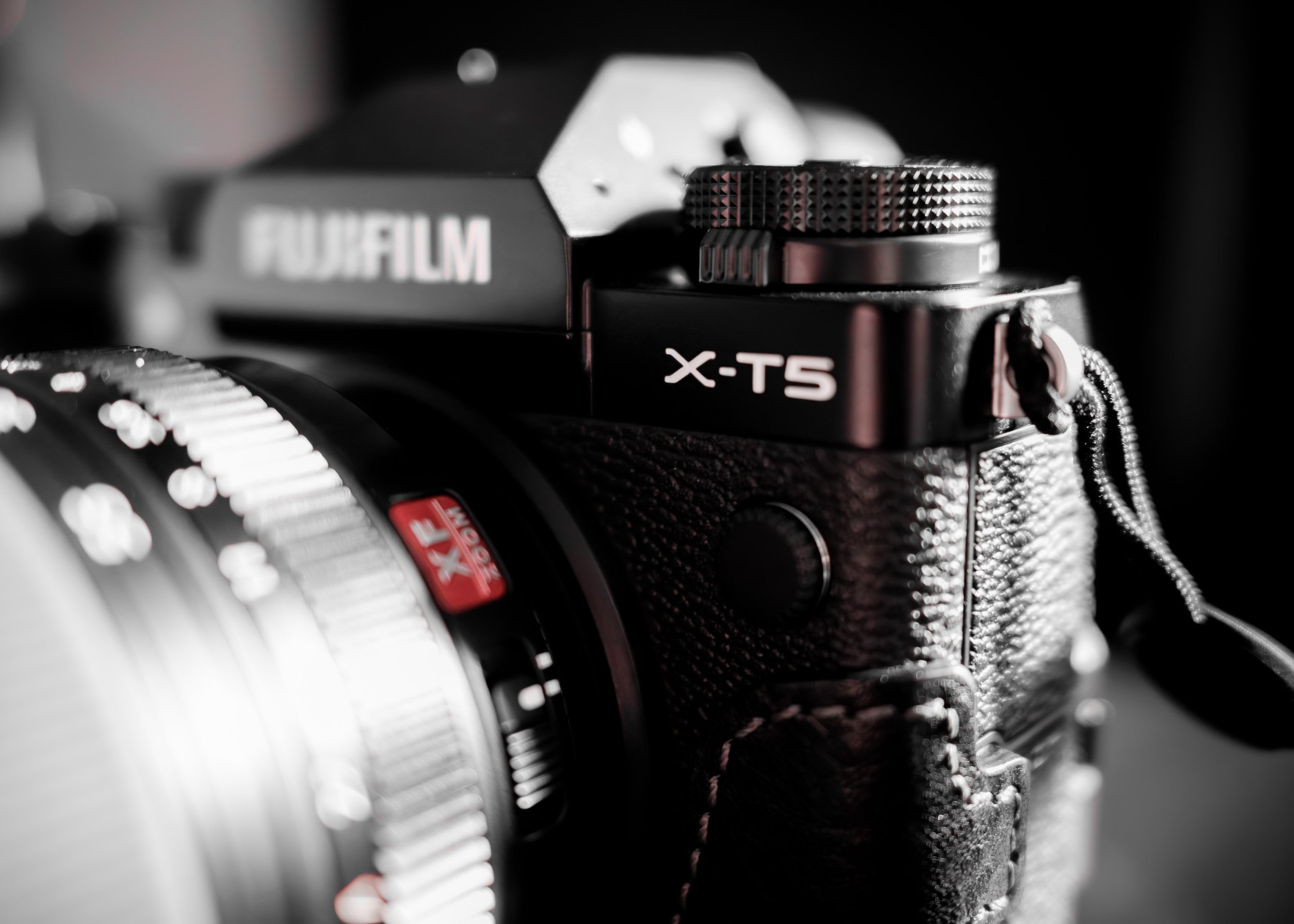
With a re-kindled passion for photography, and a growing portfolio of commercially viable photos, it’s was time to consider something more capable for big landscape shots and prints. Wanting to keep size and weight down, and needing desperately to find a camera that ‘fits’, engages, and suits my style of photography, a Fujifilm X-T5 arrived home. Still APSC, though a technically more demanding 40 megapixel sensor, the X-T5 is a small, very densely packed unit. It has its weaknesses: I don’t like the always-exposed rear screen (I’ve already broken 2 screen protectors), the black paint seems to wear quickly, and yes, the autofocus is a little random. No matter - it’s a tool that has to do its job, and it does it very well without getting in the way. I’ve pretty much nailed down the almost never-ending opportunities for customising controls, buttons, and camera settings to something that puts me on autopilot when I shoot (perhaps a subject for a later post). I love it.
Body-wise, I started with a similar leather half case / tripod mount to my X100V, but eventually swapped this for a SmallRig L-bracket cage contraption that allows for easier portrait orientation shots from a tripod. It means that the camera isn’t quite as compact and pretty, and the faux-wood grip is a little icky, but the overall weight is about the same.
I wrote in a previous blog post about my midrange zoom lens, a 16-55mm f2, and it’s a cracker. I’ve an excellent 70-300mm for telephoto work, and a wide-angle 10-24mm for the big vistas and creative wide angle shots. Under reasonably calm conditions, I tend to use the 16-55 vertically for stitched-together panoramas as opposed to the 10-24 because it’s so sharp. The great thing about these Fujifilm zoom lenses is that are tiny, compared to their full-frame cousins, as well as being a fraction of the cost.
The supporting cast
I use a small Manfrotto backpack, with less than 20 litres capacity, yet this swallows my X-T5, all 3 zoom lenses, a Dji Neo drone with a controller, spare batteries for everything, a 10,000 mAh powerbank, a dust puffer, and a few cables and tools. Easy, compact, and effective. It lived in the loft, along with the typical collection of failed camera bags that all photographers seem to own, until I dusted it off for the X-T5. It has a sternum strap and can hold my tripod in a stretchy side pocket if I really want it to. It has been upgraded by the manufacturer a couple of times and can be found online for around £80. I also have a 6L Peak Design Every Day Sling bag for strolls with a camera and one lens (I find that sling bags dig into my shoulder with any more weight). It was stupidly expensive for what it is, but it has lasted well. I tend only to use cheap wrist straps, rather than neck straps, just for a little security when taking hand-held shots. A blatant Peak Design knock-off currently does the job.
I regard tripods as a necessary evil. I prefer carbon fibre models because, as well as being lightweight, they’re not freezing cold to hold in bare hands. I prefer lever closure systems to the twist lock mechanisms (they’re faster and it’s easier to spot unlocked clamps), and the fewer sections, the better. Some travel tripods have ridiculously dainty final legs. My SmallRig AP-10 is about the best cost/sturdiness/weight/size compromise that I’ve found. It’s not perfect and it can begin to droop with the long zoom lens fully extended, but it’s otherwise solid. I’ll perhaps one day consider an upgrade, but find it hard to justify spending over £200 on 3 sticks…
My 16-55 and 10-24 lenses both take 72mm filters (telephoto work rarely needs filters of any sort, but I have a step-up ring if it’s absolutely needed). I use K&F Concept magnetic filters and lens caps. They’re optically decent, and easy to swap between lenses. A circular polariser, and a couple of ND filters is all I need. One tip for magnetic filters: Get yourself a mini jewellery microscope as magnetic filter rings eventually develop their own grinding paste of microscopic pieces of metal (especially if you drop them), and a carefully directed stronger magnet is the only way to remove it.
Like I said, a bit boring. Now let’s go and take some photos - the sun is finally out.
